
'The Make in India target of getting manufacturing to account for 25% of GDP by 2022 is quite impossible to achieve.' 'As for the role of technology in the average Indian's life, it is still quite basic -- mobile phones and Mars successes notwithstanding,' says T N Ninan.
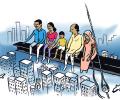
The new scheme may be announced before the Lok Sabha elections.

"During the Congress regime, the news headlines were of India handing over another dossier to Pakistan about terror activities. Some of our friends in media used to clap after such any such dossier was sent," Modi said at an election rally in Maharashtra's Latur.
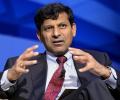
Former Reserve Bank Governor Raghuram Rajan said India will still remain a lower middle country if the potential growth rate remains at 6 per cent annually without any rise in population by 2047 (Amrit Kaal) and will be reaching the end of the demographic dividend by then. Speaking at a programme organised by Manthanon on Saturday, the economist said if the country does not grow faster, it will grow older (demographically) before it gets richer, which means there is the burden of an aging population to deal with also at that point. Rajan said the GDP growth in India for the past two quarters was in the region of 7.5 per cent and if one looks at the labor force participation, it is very low and when it comes to female participation, "it is the lowest in the G20".

'In times of recovery, we may see a rural-urban divide with the urban pockets affected more by COVID-19, but the MFI business model should encourage banks to handhold them in this hour of crisis,' notes Tamal Bandyopadhyay.

Social stock exchange (SSE) saw its first listing on Wednesday, with SGBS Unnati Foundation becoming the first entity to take this route to avail financing. The foundation - engaged in vocational training of youth - raised Rs 1.8 crore from four investors. These include brokerage firm Zerodha and National Bank for Agriculture and Rural Development (Nabard).

The point made by sociologist M N Srinivas, that it represented a Sanskritic act that was linked to caste, is never raised in Indian debates and the disapproval of drink is almost universal, notes Aakar Patel.

Warning that India's farm subsidy had mounted to 5.6 per cent of agriculture GDP, the World Bank on Wednesday said the country should instead be investing more in rural education, social and infrastructure development.

Indian exporters shipping goods to Israel may face higher insurance premiums and shipping costs due to the Israel-Hamas conflict, according to experts. Israel witnessed a surprise and unprecedented multifront attack by air, land and sea by the Hamas militant group, which rules the Gaza Strip, in its southern parts on Saturday morning. The International trade experts said the conflict may reduce the profits of domestic exporters but will not impact trade volumes unless war escalates.

States have been told to prepare in advance to counter any impact of an adverse southwest monsoon.

Analysts and economists have hailed the fiscal projections in the interim Budget, saying the lower fiscal deficit forecast shows that the government, even in an election year, is serious about fiscal consolidation and that the numbers look achievable. According to Devendra Kumar Pant, the chief economist at India Ratings, the two broad themes of the interim Budget are fiscal consolidation and stepping up focus on agriculture/rural to course correct, to some extent, the differential benefits of the ongoing economic growth that's tilted in favour of upper-income bracket/urban households. The projected fiscal deficit numbers for FY24 and FY25 suggest that the government is serious about achieving the fiscal consolidation path of 4.5 per cent fiscal deficit by FY26, and given the nominal GDP growth assumption and revenue buoyancy, the target appears plausible, Pant said in a note.

Buoyed by an increase in public investment and incentives to boost manufacturing, India's economy is expected to grow by 8.3 per cent in the fiscal year 2021-22, less than the previous projection early this year before the country was hit by the second wave of the COVID-19 pandemic, the World Bank has said in its latest report. World Bank chief economist for the South Asia Region Hans Timmer told PTI here that when one looks at the high frequency data, they see that as a result of the second wave of the COVID-19 pandemic, the recovery paused, and some indicate that the recovery actually declined briefly. "We project for this fiscal year 8.3 per cent (growth rate for Indian economy) that is less than we projected early in the year before the health crisis caused by the second wave. "Given the sharp contraction of the economy last year, it might not look like a lot, but in my view, that is actually very positive news, given the violent second wave and the severity of the health crisis," he said on Thursday.

Fundraising activity in the debt market is gaining momentum ahead of the festival season. Several non-banking financial companies (NBFCs) and the National Bank for Agriculture and Rural Development (Nabard) are planning to raise at least Rs 5,560 crore in the next two days by issuing bonds, with a greenshoe size of Rs 6,370 crore. Ajay Malglunia, managing director and head of investment grade group at JM Financial, said, "The market likes certainty, the market will gain clarity after the US Federal Reserve's (Fed's) policy.

Mudra Bank will be a Rs 20,000-crore institution, which would "primarily be responsible for refinancing all micro-finance institutions.
Attacking the industrialised countries for agricultural protectionism, which was hurting the economies of poor nations, the World Bank has stressed that global trade liberalisation was critical for reducing poverty in developing countries.
The Bank suggested reforms in infrastructure sector.
An early action to allow domestic banks to participate in the commodity markets would not only help in improving their competency but would also help in develop their trading and product development skills in commodity derivatives.

Record liquidity infusion by the central bank in the banking system during the financial year 2020-21 amid sluggish economic activity resulted in banks investing more in safe government papers than in extending loans, data from Reserve Bank of India (RBI) showed. This trend has not been seen in nearly two decades, barring 2016 - the year of demonetisation.

'If because of El Nino, the monsoon is affected adversely in the current year, naturally it will affect income projections and consequently Budget numbers.'

'We will see a lot of investments from the private sector.' 'As long as we are not impacted by some global events, I think we will be in a strong place.'


A 'White Paper' versus 'Black Paper' battle erupted on Thursday as the Centre and the Congress unveiled documents and crossed swords over the handling of the Indian economy during the nearly 10 years of the BJP-led NDA rule and the previous 10-year tenure of the Congress-led UPA government.

In India, economic activity slowed substantially in 2019, with the deceleration most pronounced in the manufacturing and agriculture sectors, whereas government-related services sub-sectors received significant support from public spending, the Bank said.

This election will be remembered for being the first election where the Election Commission failed to take action on gross violations involving the ruling party that repeatedly used religion, communal slurs, lies and undocumented allegations, observes Ramesh Menon.

The accused were allegedly complicit in causing losses to the tune of Rs 1,000 crore to MSCB between 2007 and 2011.

Could the MPCE survey results be used as a basis of reconstructing the Consumer Price Index with new weights, asks Madan Sabnavis.

Wayanad will continue to support Rahul but not to the same extent as in 2019, when his margin of victory had been enormous. Articulate, to the point and speaking in fluent Malayalam, CPI's Annie Raja, had the people who gathered to see her, listening in rapt attention, notes Shyam G Menon.

The BJP is banking on development. The opposition is raking up caste identities and the dangers of hyper nationalism.

The country needs 100 million jobs in the formal sector in the next decade to take advantage of its demographic dividend. Also, it should get into the global supply chain to generate many of those by negotiating trade deals effectively, industry players and experts have said. "We need something like 100 million jobs in the next 10 years, which means that the non-agriculture sector has to generate 14 per cent job growth every year," said Aditya Ghosh, co-founder of Akasa Airlines, at the Global Economic Policy Summit organised by the CII.
Multiple organisations of different kinds with overlapping goals would be a dream situation for those who believe in competition and innovation.

'Although strong arm tactics do cause inconvenience, they have not been able to stop us from carrying out our campaigns.' 'Allegations about being 'anti-development' mean very little when people in the country are still going hungry.' Greenpeace India chief Ravi Chellam on the challenges ahead.

The interest offered is mostly 0.5 to 1 per cent more than what other banks offer. Moreover, customer service and long-term association spanning generations are also other reasons for the popularity.

Timely preparation and picking the right questions will help you crack these examinations and secure a job.

Prime Minister Narendra Modi Wednesday said the International Monetary Fund (IMF) sees India as a "bright spot" in the global economy and as per the World Bank, India is in a better position to deal with the global headwinds than many other countries. This is because of India's strong "macroeconomic fundamentals", Modi said while virtually addressing the inaugural function of the 7th edition of Invest Madhya Pradesh-Global Investors Summit in Indore. In the past eight years, the government has increased the speed of reforms and removed many hurdles in the way of investments.

'When the average growth in the last three years was just 2.5%, how does that make us the fastest growing country?' 'They only tell you what has happened in the last 2 years; they are not taking into account what happened in FY21 on account of their mistakes.'
Control over PSU banks is what is allowing the government to drive this scheme.
World Bank economists have urged the Indian government to cut unproductive farm subsidies and utilize agriculture spending the most productive manner.
The RBI reminded that the primary role of these banks is to lend for activities related to agriculture and rural development. The central bank said it has come to its notice that certain state cooperative and central cooperative banks have extended finance to the sector.
 © 2026 Rediff.com - Advertise with us - Disclaimer - Privacy Policy - Sitemap - Feedback - About us - Terms of use - Grievances